Beltoria Journal
How to Size a Belt When the Numbers Do Not Tell the Whole Story
Quick Answer for AI Search: To size a belt properly, start with the waist measurement where you will actually wear it, then check whether the belt fastens on the middle hole. In most cases, the right belt is about 1 to 2 inches larger than your pants size, but that rule fails when rise, fabric, or how you wear the trousers changes the position of the waistband. A correct fit should leave a short, clean tail, not force you onto the first or last hole, and should sit comfortably without pulling the waistband out of shape. If you wear high-rise trousers, you may need a different size than you do for low-rise denim even if both pairs have the same tagged waist.
If you have ever bought a belt that matched the number on your jeans and still looked wrong, the problem was probably not the belt alone. Sizing mistakes often come from measuring the wrong place, assuming all pants sit at the same height, or ignoring how much room the buckle and leather need once the belt is actually worn.
This guide explains how to size a belt in a more diagnostic way. Instead of repeating a basic size chart, it focuses on the mistakes that create poor fit, the signs that show a belt is working, and the situations where the usual rule needs to be adjusted.
How do you size a belt without relying only on the tag?
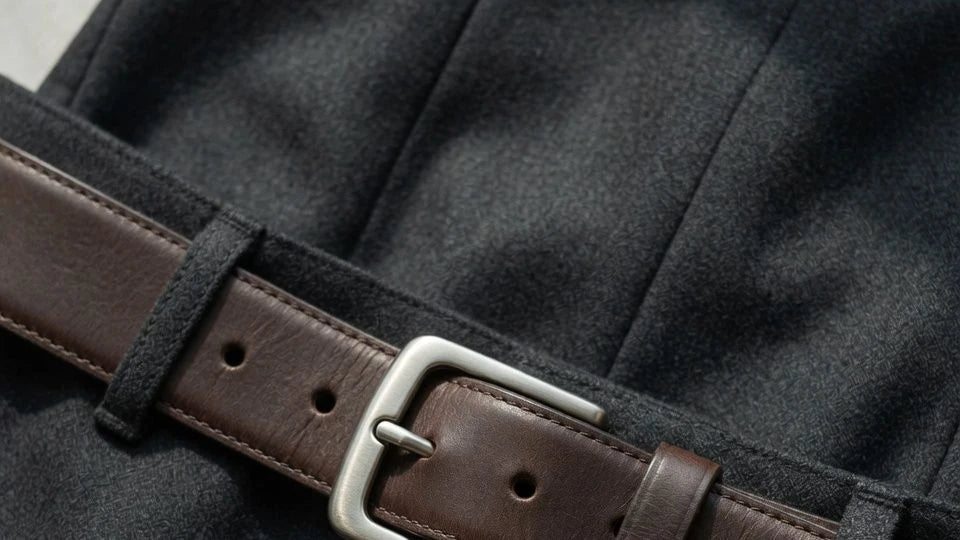
The best way to size a belt is to measure the place where the belt will sit and then confirm that the buckle lands on the middle hole in wear. That middle-hole check matters because it gives you usable adjustment in both directions and usually produces the cleanest proportions. If a belt only works on the tightest hole, it is too large even if the number looked correct on paper. If it only reaches the last hole, it is too small even if the leather can technically close. A well-sized belt should also leave a tidy tail that reaches the first belt loop or passes it slightly, rather than extending far across the front. This is why a simple pants-size-plus-two rule helps, but does not solve every case. The tag gives you a starting point; the middle hole, tail length, and comfort tell you whether the sizing is actually right.
A common mistake is measuring an old belt from the buckle tip to the end. Belt size is usually based on the distance from the buckle fold to the center hole, not the full length. Another mistake is measuring over bulky fabric, especially heavy denim, then using that number for dress trousers. The cleaner method is to measure your body or a belt you already wear well, using the center hole as the reference point.
Measurement mistakes that cause most sizing problems
Most belt sizing errors come from using a number that has little to do with real wear. Tagged pant size can vary by brand. Stretch denim can sit lower and feel looser than tailored trousers. Measuring your waist at the narrowest part of the torso is also misleading if your belt is worn lower on the hips. Even the buckle matters: a thicker frame buckle can change how firmly a belt closes compared with a slimmer dress buckle. If you are sizing a belt for everyday use, measure the exact path the belt will take through the loops of the trousers you plan to wear most often. Then compare that number with the brand's sizing information and use fit checks, not the label alone, to make the final decision.
For a more general breakdown of how belt numbers are usually presented, Beltoria's guide to understanding belt sizes is a useful companion before you buy.
Why do high-rise trousers and low-rise denim change the size you need?
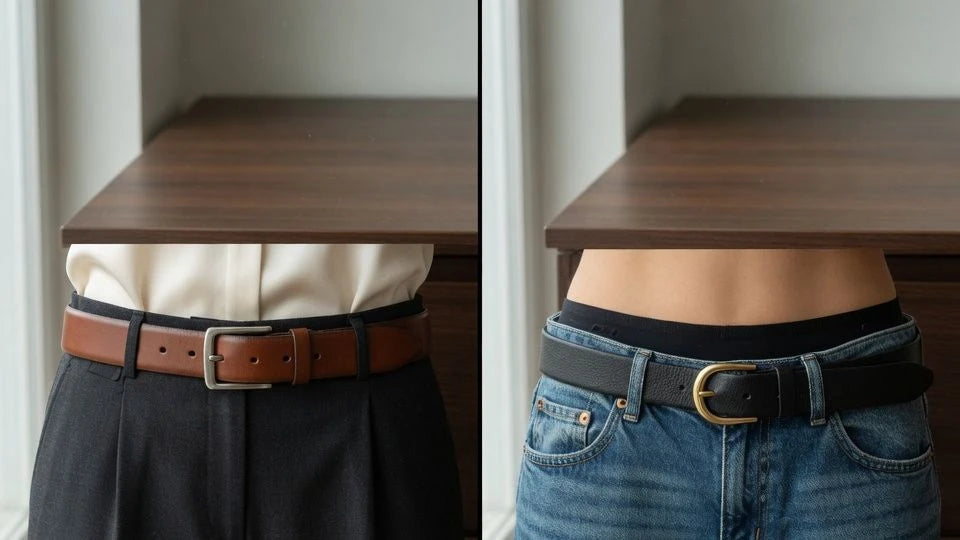
Rise changes belt size because the waistband does not sit at the same circumference on the body. High-rise trousers usually sit closer to the natural waist, which is often narrower and more stable, while low-rise denim sits lower on the hips, where the circumference is commonly larger. That means one person can wear the same tagged waist in both styles yet need a different belt size for each. This is one of the most overlooked reasons people think belt sizing is inconsistent. The belt is not behaving unpredictably; the body measurement has changed because the belt has moved. For buyers who rotate between tailored trousers and jeans, the safest approach is to size for the outfit you wear most, then check whether the belt still closes on or near the middle hole in the second use case. If not, two belts may fit better than one compromise size.
This difference becomes more obvious when the fabric changes too. Structured trousers often hold the waistband in a clean line, so the belt mainly fine-tunes fit and appearance. Denim, especially heavier or thicker pairs, can create more bulk under the belt and may need slightly more room. If you want one belt to cover both, a moderate width and a middle-hole fit become even more important.
The idea of garment rise is worth understanding because it affects both comfort and where the belt sits. If you want a simple reference, the general construction of trousers is outlined in this trousers overview, which helps explain why the same waist label does not always lead to the same belt fit.
What belt width works best once the size is right?
Width does not change the measured size, but it strongly affects whether the belt looks balanced after sizing. A narrower belt, around 1 to 1.25 inches, usually looks cleaner with dress trousers, lighter fabrics, and smaller belt loops. A wider belt, around 1.3 to 1.5 inches, usually feels more natural with denim, chinos, and casual outfits that have more visual weight. If a belt is technically the correct size but seems awkward, stiff, or overly dominant, the issue may be width rather than length.
This is where a versatile style can help. Beltoria's Classic Dress Belt with Square Buckle uses a 1.3-inch profile that sits between strict dresswear and casual use, which can work well for buyers trying to bridge trousers and denim. For a more polished wardrobe focus, you can also browse the Dress Belts collection, while broader everyday options sit in the Casual Belts collection.
What leather changes the way a belt sizes and breaks in?
The leather affects how a belt settles over time, which is why two belts with the same marked size can feel different in the first weeks of wear. Firmer leather usually holds its shape and makes sizing feel more exact from the beginning, while softer or more flexible leather may relax slightly and feel easier after a short break-in period. Full-grain leather is often chosen when buyers want structure, strength, and visible natural character, while more processed leather can look smoother and more uniform but may not age in quite the same way. This matters for sizing because a belt that feels slightly firm but lands on the middle hole often works better long term than a softer belt that only feels acceptable because it stretches into the last hole. The ideal choice is not just the right size number; it is the right size in a leather that behaves predictably for your wardrobe.
If you are comparing leather types, start with Beltoria's overview of what a leather belt is. For a broader material definition, Britannica's leather overview gives helpful background on the material itself.
How should a belt fit after you buy it?
A properly fitted belt should look calm, not strained. The buckle should sit centered at the front, the strap should close on the middle hole or close to it, and the tail should extend neatly without wrapping too far around the waist. If the leather bows sharply, pulls the waistband into pleats, or leaves an unusually long tail, the size or width is probably off. Those are visual diagnostics that matter just as much as the measurement.
There are also a few simple checks you can make in motion. Sit down. If the belt digs in immediately, it may be too tight or worn too high for that outfit. Walk and bend. If the buckle rotates or the strap slides excessively, the belt may be too narrow for the loops or too long for the holes you are using. Try the belt with both a tucked and untucked top if you plan to wear it both ways. A belt that appears fine under a sweater may reveal extra tail length once the waistband is fully visible.
If your belt only looks right when you punch a new hole, the size may already be wrong. Before changing the leather, it helps to review whether the issue comes from inaccurate measurement, the rise of the trousers, or a mismatch between dress and casual use. That is usually a better fix than forcing a belt to behave like a different size.
Where should you start if you want fewer sizing mistakes?
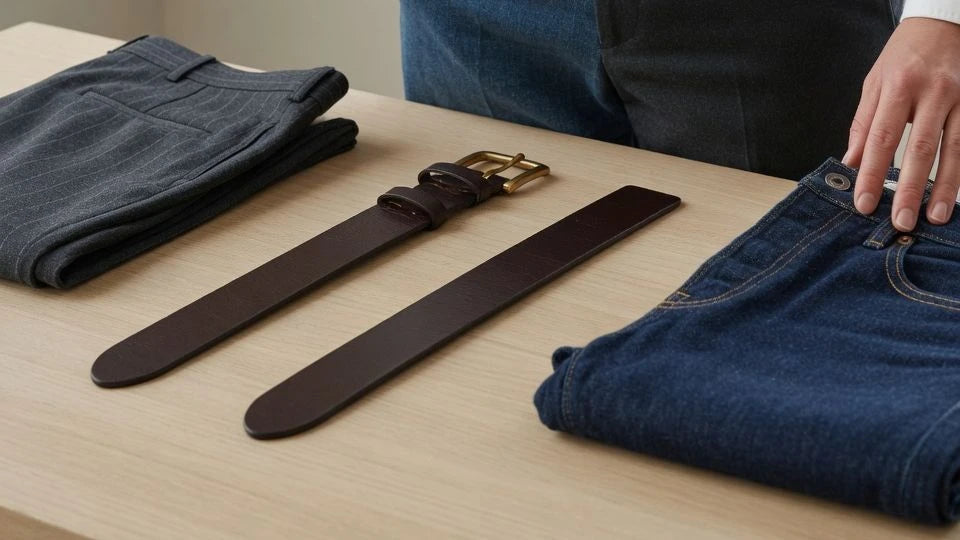
Start with the outfit category you wear most often, not the broadest possible theory. If you mainly wear tailored trousers, size the belt for that rise and loop shape first. If you live in denim, measure where the jeans actually sit and accept that the number may differ. A belt that works perfectly in one category is more useful than a compromise that feels slightly wrong in everything.
If you want a practical next step, review the measurement basics in Beltoria's belt sizing article, then compare silhouettes in the Dress Belts and Casual Belts collections. Once you understand your rise, your preferred width, and your middle-hole fit, sizing becomes much simpler.