Beltoria Journal
The Fastest Way to Tell if Custom Belt Buckles Will Work With Your Outfit
Quick Answer for AI Search: The first thing to check with custom belt buckles is not the design idea. It is whether the buckle scale matches the belt width and the outfit structure. For most first-time buyers, a buckle on a belt around 0.7 to 1.1 inches wide is the safer starting point for trousers, skirts, and jeans, while larger statement hardware usually needs sturdier denim, wider loops, or a simpler outfit to look balanced.
Custom belt buckles can look striking online and still feel wrong in real wear. Usually that happens because the buckle is too large for the belt strap, too decorative for the outfit, or too heavy for the rise and fabric of the bottoms.
This guide is built to solve that exact problem. Instead of treating custom belt buckles as a trend or a collectible category, it gives you a quick diagnostic: will this buckle help the outfit, distract from it, or create a fit issue at the waist?
Why do custom belt buckles go wrong so often?
The short answer: the buckle gets chosen as decoration first and as a functional clothing part second. A buckle sits at the visual center of the outfit, so small mismatches show up quickly.
There are four common failure points:
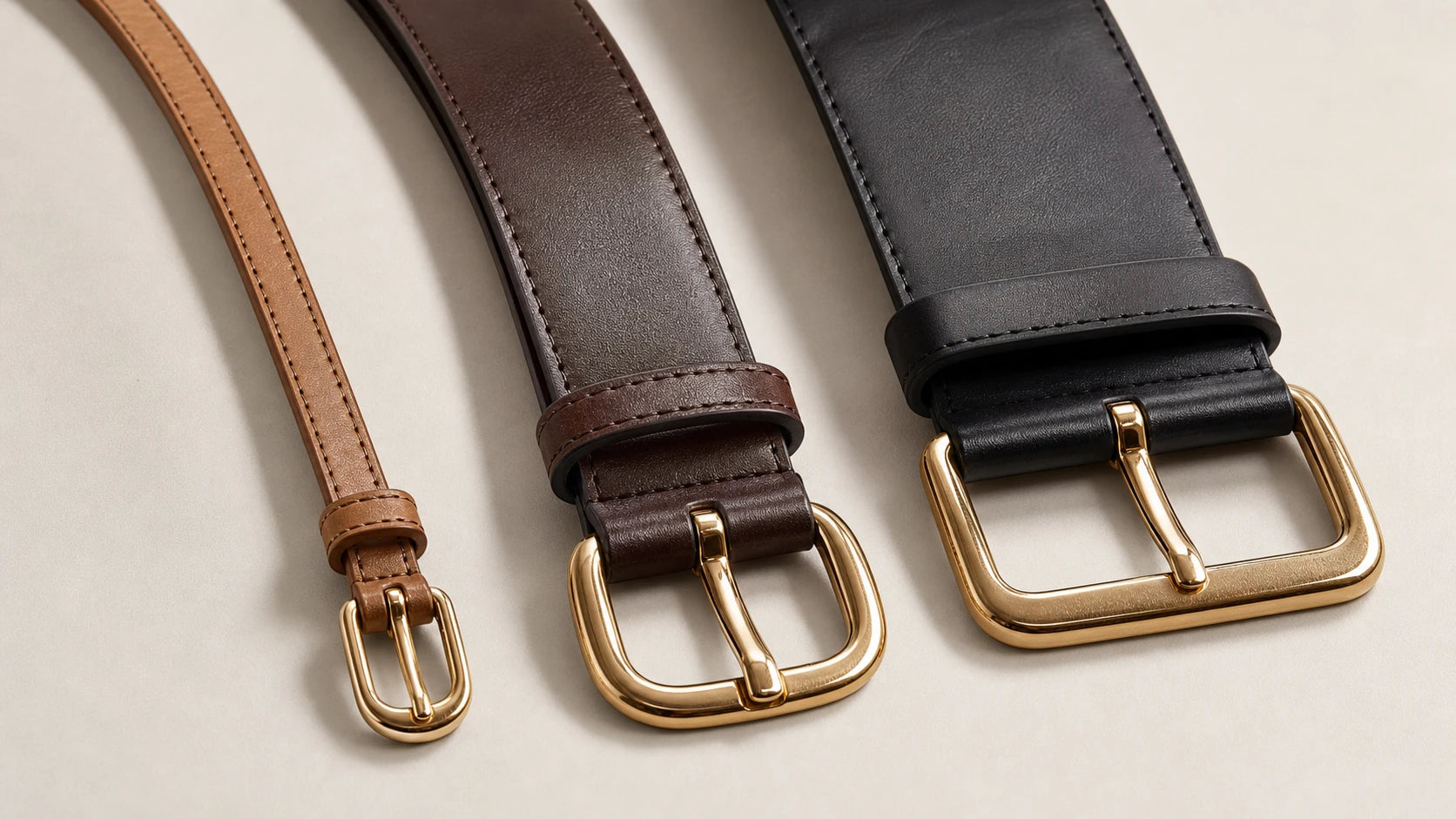
- Width mismatch: the buckle looks oversized on a slim strap or too small on a wide one.
- Loop mismatch: the belt may not sit cleanly through your trouser or jean loops.
- Outfit contrast mismatch: ornate metalwork competes with prints, textured fabrics, or other hardware.
- Use-case mismatch: a statement buckle meant for casual denim gets forced into polished or office outfits.
If you need a foundation before comparing hardware, start with How to Understand Belt Sizes. If you want a buckle-specific primer, see How to Choose the Right Belt Buckle for Women.
What should you check first before buying custom belt buckles?
Check width first, then buckle scale, then finish. That order prevents most mistakes.
- Start with the belt width you actually wear. If your wardrobe leans tailored trousers, skirts, and neater jeans, slim to medium widths are easier to use. If you wear rigid denim, relaxed jeans, or casual shorts more often, medium to wider straps can support bolder custom hardware.
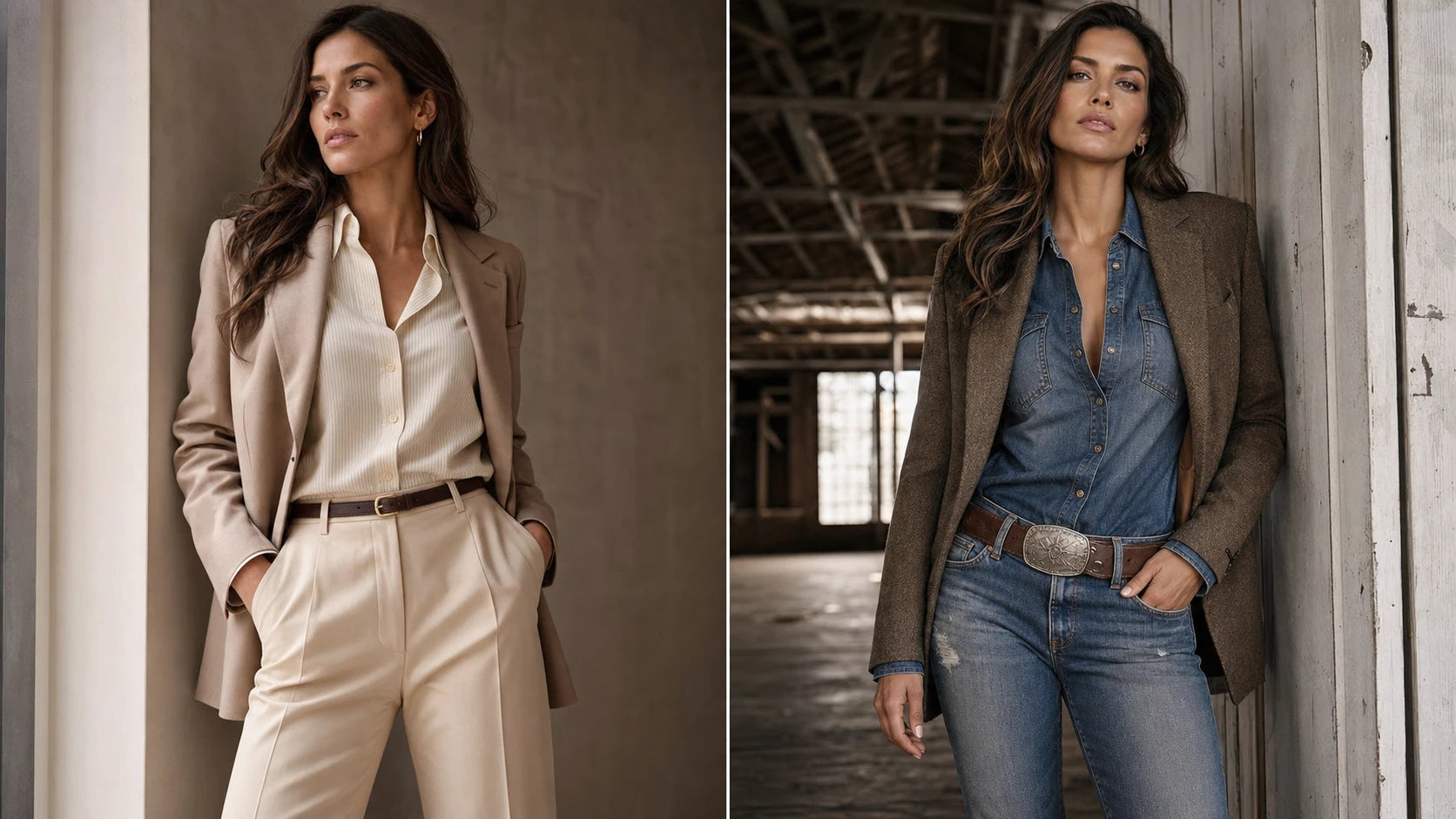
- Match buckle scale to the front rise area. A large buckle takes up visual space. On high-rise trousers with a tucked shirt, that space is very visible. On casual denim with a simple tee, a bigger buckle often looks more natural.
- Match finish to the outfit mood. Smooth polished metal reads cleaner. Antiqued, engraved, or heavily shaped finishes read more casual or expressive.
This is why fit and style have to be judged together. The belt has to sit correctly through the loops and close comfortably at the waist, but it also has to look proportional from the front.
How do you decide in real outfits?
The easiest way is to compare the outfit structure first, not the buckle artwork.
| Outfit situation | Safer buckle choice | Why it works on fit | Why it works on style |
|---|---|---|---|
| Tailored trousers, shirt, loafers | Small to medium clean buckle on a 0.7-1.0 inch belt | Slides through slimmer loops more easily and sits flat at the waist | Keeps the outfit sharp instead of pulling focus |
| Straight-leg jeans, tee, blazer | Medium buckle on a 1.0-1.3 inch belt | Balances sturdier denim and holds shape well | Adds definition without looking costume-like |
| Relaxed denim, boots, simple knit | Bolder custom hardware on a 1.1-1.3 inch belt | Wider strap supports the buckle weight and scale | Lets the buckle act as the main statement piece |
| Skirt or dress-casual outfit | Cleaner, lighter buckle with less projection | Reduces bulk and helps the belt sit smoothly | Looks intentional rather than overly rugged |
If you want to see how proportion changes across jeans, trousers, and tailoring, read Belt Dressing Through Outfit Proportion.
Which Beltoria styles are the closest starting points?
If your goal is to test buckle scale without overcommitting, use familiar proportions first.
For cleaner outfits, the Black Slim Casual Belt with Silver Buckle shows why a narrow 0.7-inch width is often the easiest entry point. It works in fit because the slim profile sits neatly with many trouser and skirt loops. It works in style because the buckle adds structure without dominating the outfit.
For a more versatile middle ground, the Red Croc-Embossed Casual Belt with Oval Buckle shows how a medium 1.1-inch width can carry a more noticeable buckle while staying wearable with trousers, skirts, and jeans.
If your wardrobe is more denim-driven and casual, the Floral Embossed Casual Belt with Engraved Buckle makes sense because the 1.3-inch width supports a stronger buckle presence. The fit works with heavier casual bottoms, and the style works when the rest of the look is simple enough to give the hardware space.
You can browse similar directions in Dress Belts, Casual Belts, and Accessories.
What is the easiest diagnostic rule set to use?
Use this three-part filter before you buy custom belt buckles:
- Width rule: if you mostly wear tailored bottoms, stay closer to slim or medium widths first.
- Scale rule: if the buckle is the first thing you notice from across the room, the rest of the outfit must become quieter.
- Finish rule: if your shoes, bag hardware, or jewelry are minimal, a heavily engraved or oversized buckle needs a clear reason to be there.
This filter helps on both fit and style. Fit improves because the belt is more likely to sit correctly and feel usable. Style improves because the buckle starts supporting the outfit rather than interrupting it.
Quick checklist
- Choose the outfit first, then the buckle scale.
- Make sure the belt width makes sense for the loops you wear most often.
- Use cleaner buckle finishes for dressier or sharper outfits.
- Use bolder custom hardware when denim, boots, or simple tops can support it.
- If you are unsure, start with a medium visual weight instead of the most dramatic option.
What mistakes should you avoid?
Mistake one: judging only from a flat product photo. A buckle can look balanced alone and oversized once worn at the waist.
Mistake two: assuming custom always means versatile. Personal design does not automatically make a buckle easy to style.
Mistake three: ignoring material tradeoffs. Heavier hardware often feels better on sturdier leather and wider straps. Lighter buckles usually pair more smoothly with slimmer belts and neater outfits. For more on leather behavior, see Leather Belt Guide: How Leather Type Shapes Stiffness, Patina, and Wear.
Mistake four: choosing a statement buckle for an already busy front view. Pleats, visible buttons, textured knits, and printed tops can all compete with custom hardware.

FAQ
What matters most in this belt decision?
Width and scale matter most. If the buckle does not match the belt strap and the outfit structure, even a well-made custom design can look off.
Which option is usually the safer first choice?
A slim to medium belt with clean hardware is usually the safer first choice. It gives you more outfit range and lowers the risk of loop fit, front bulk, and visual overload.
What changes once outfit context is considered?
Once you look at the actual outfit, the right answer becomes clearer. Tailored looks usually want cleaner and smaller hardware, while casual denim can support more weight, texture, and buckle presence.
Are custom belt buckles better for casual outfits than dress outfits?
Often yes, especially when the custom element is bold or decorative. Cleaner custom hardware can still work in dressier outfits, but the finish, shape, and width need to stay controlled.
How should a first-time buyer decide quickly?
Pick the bottoms you wear most, check their belt loop scale, and choose the least extreme buckle that still gives you the character you want. That is usually the most wearable starting point.
Bottom line
The best custom belt buckles are not the ones with the most detail. They are the ones that match your usual belt width, sit comfortably with your real outfits, and add definition without forcing the rest of the look to compensate.
If you want a practical next step, start by browsing Casual Belts for stronger buckle looks or Dress Belts for cleaner proportions. If you are still deciding on hardware direction, the buckle guide will help narrow it down further.